Kari KurjiakaJuly 01, 2026
Read the Full Blog HereNew Research on the Ecosystem that is Changing Early Literacy in NYC
I’m sure everyone reading this has had the privilege of experiencing that magical moment when a child receives a new book. Their eyes light up, they start talking about the picture on the cover, and immediately open the pages. These magical moments happen all across New York City, in libraries, child care centers, community based organizations, and in health clinics.
I’ve felt honored to contribute to this early literacy ecosystem as the Director of Medical Engagement at Reach Out and Read of Greater New York where we partner with health clinics and pediatricians to provide brand-new books and literacy counseling to children and families, encouraging those magic moments of reading together. With conversations of early relational health only rising in importance, the medical professionals who implement Reach Out and Read take the moments they have with children 6 months to 5 years old during their regular well check-ups to give them a new book, use the book during the visit, and encourage more of these bonding moments as parents and children read together at home.
But Reach Out and Read is not in this alone. We know there is no one-program solution to early literacy. It’s through our partnerships with other organizations where we can see the most significant impact. This is exactly what we found in the latest research from City’s First Readers.
The abstract is titled “Population-level integration of early literacy programs across health care and community settings: Evidence for reach and impact,” and highlights the success of City’s First Readers (CFR); a New York City Council-funded initiative led by Literacy in Community (LINC) that unites 17 early literacy organizations in NYC under one title and one collective mission. As part of Reach Out and Read, we reach families through the healthcare system along with PlayReadVIP while our other CFR partners continue to support children through community based programming like LINC, home visiting like ParentChild+, and all three of the public libraries in the city, New York Public Library, Brooklyn Public Library, and Queens Public Library.
The research demonstrates that when literacy programs are integrated across systems sectors, they create a “scalable public health model” that significantly boosts family engagement. Key findings from the study highlight:
Measurable Impact
- Caregivers reported reading frequency increased, with the percentage of families reading three or more days per week rising by 28 percentage points, alongside a 27 percentage point increase in the proportion of families with 10 or more children’s books in the home.
- Interactive shared reading increased across all measures, with gains of more than 20% in key behaviors like pointing to pictures and asking questions
- Parents reported reading more often and earlier, increased confidence and knowledge, and stronger parenting practices.
Massive Scale
- CFR partners reach hundreds of thousands of children and families every year through a scalable cross-sector ecosystem.
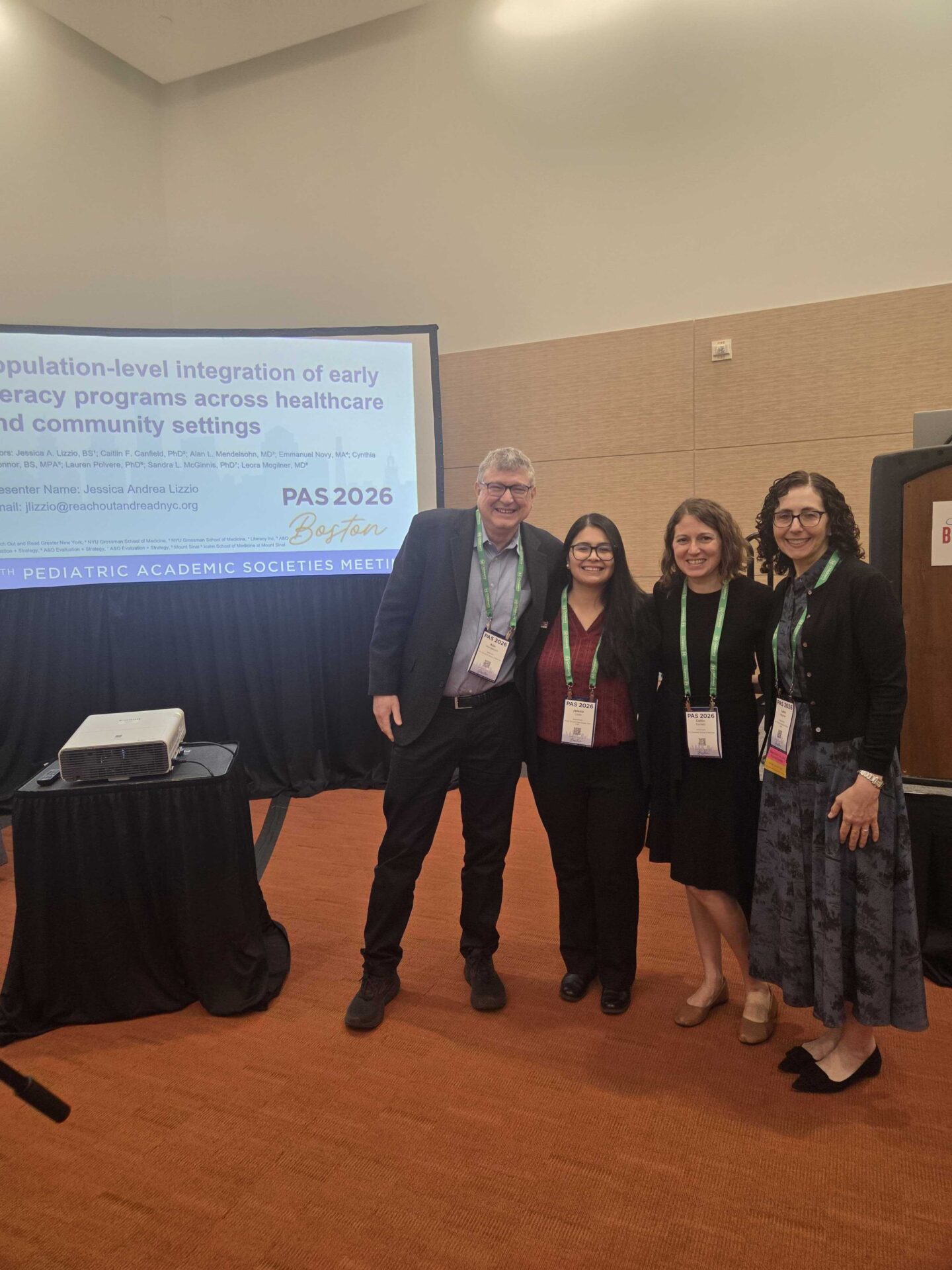
In addition to this exciting new insight, this research was selected for an oral presentation at the Pediatric Academic Societies (PAS) 2026 Meeting in Boston this April. A win for early literacy and an example of the power of partnerships!

Study co-authors: Jessica A. Lizzio, BS; Caitlin F. Canfield, PhD; Alan L. Mendelsohn, MD; Emmanuel Novy, MA; Cynthia O’Connor, BS, MPA; Lauren Polvere, PhD; Sandra L. McGinnis, PhD; Leora Mogilner, MD